

Achalasia surgery in Oxford (Laparoscopic Heller's myotomy)
Achalasia is a rare condition affecting the oesophagus that can cause difficulty swallowing, regurgitation, and weight loss.
I provide specialist assessment and surgical treatment for achalasia in Oxford, offering a structured approach to diagnosis and personalised treatment.
Most patients are seen within 1-2 weeks of enquiry
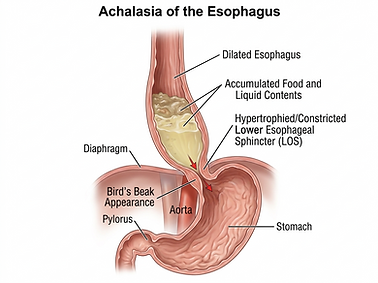
What is achalasia?
Achalasia is a disorder of oesophageal motility in which:
-
The lower oesophageal sphincter fails to relax properly
-
The oesophagus loses its normal coordinated movement
This leads to difficulty in passing food into the stomach.
At present we don't understand why it happens.
Symptoms of achalasia
Common symptoms include:
-
Difficulty swallowing (dysphagia), for both solids and liquids
-
Regurgitation of food
-
Chest discomfort
-
Weight loss
-
Nocturnal symptoms or coughing
Symptoms often develop gradually and may be mistaken for reflux.


Achalasia symptoms vs oesophageal cancer
Oesophageal cancer can present in a similar fashion to achalasia, with progressively worsening difficulty in swallowing.
If you have difficulty swallowing you should seek urgent assessment with endoscopy to exclude oesophageal cancer, via your GP, any private gastroenterologist or within my practice.
Most patients with achalasia who I see have been appropriately investigated with endoscopy (OGD) before referral through the most expeditious route prior to seeing me.
Achalasia diagnosis
Accurate diagnosis is essential before treatment.
Investigations typically include:
-
Oesophageal manometry (key diagnostic test)
-
Endoscopy (to exclude other causes)
-
Barium swallow (to assess oesophageal function and shape)
These tests confirm the diagnosis and help guide treatment decisions.


Treatment options for achalasia
Treatment aims to relieve obstruction at the lower oesophageal sphincter.
Options may include:
-
Balloon dilatation
-
Botulinum toxin (Botox) injection
-
Keyhole surgical or endoscopic myotomy
The most appropriate option depends on age, fitness, and disease subtype.
Laparoscopic Heller's myotomy
Surgical treatment typically involves a laparoscopic Heller myotomy.
This involves:
-
Dividing the muscle fibres at the lower end of the oesophagus
-
Allowing food to pass more easily into the stomach
Benefits include:
-
Effective relief of swallowing difficulty
-
Durable long-term results
-
Minimally invasive (keyhole) approach
Some surgeons advocate a partial anti-reflux procedure as part of a Heller's myotomy. This is not my practice as in my experience this is rarely needed for control of reflux, and carries the risk of ongoing difficulty swallowing due to the anti-reflux procedure.


POEM (per-oral endoscopic myotomy)
Some patients may be suitable for POEM, a purely endoscopic treatment.
I will assess and advise whether:
-
Surgical treatment
-
Endoscopic treatment
-
Or alternative management
is most appropriate in your case.
Please note I offer surgical treatment and if you were to elect to pursue endoscopic treatment I would refer you to a colleague.
Specialist assessment is essential
Achalasia is a complex condition, and outcomes depend heavily on:
-
Accurate diagnosis
-
Correct classification (subtype)
-
Appropriate selection of treatment
I provide a carefully structured assessment pathway to ensure optimal outcomes.


Self-pay achalasia treatment in Oxford
-
I offer a specialist self-pay pathway:
-
Rapid access to consultation
-
Coordination of investigations
-
Individualised treatment plan
-
Guide price:
-
£8,000 – £12,000 (surgical treatment)
-
A personalised quotation will be provided following assessment
Why choose my practice
-
Experienced consultant general surgeon
-
Specialist interest in upper GI conditions
-
Expertise in minimally invasive oesophageal surgery
-
Careful patient selection and investigation
-
Multidisciplinary approach where required
-
Clear, honest and evidence-based advice, including when surgery would not be appropriate


Achalasia vs acid reflux
Achalasia and acid reflux (GERD) can sometimes cause similar symptoms, but they are very different conditions requiring different treatments.
Achalasia
-
A problem with the movement of the oesophagus
-
The lower oesophageal sphincter fails to relax properly
-
Food has difficulty passing into the stomach
-
Symptoms:
-
Difficulty swallowing (both solids and liquids)
-
Regurgitation of undigested food
-
Weight loss
Acid Reflux (GERD)
-
A problem with a weak valve at the lower end of the oesophagus
-
Stomach acid flows back into the oesophagus
-
Symptoms:
-
Heartburn
-
Acid regurgitation
-
Throat or chest symptoms
Why This Matters
-
The treatments are very different:
-
Reflux is treated by strengthening the valve (e.g. fundoplication)
-
Achalasia is treated by relaxing the valve (e.g. myotomy)
-
For this reason, accurate diagnosis is essential before any treatment is considered.
-
I provide a structured assessment to ensure the correct diagnosis and the most appropriate treatment plan.
Book a consultation
If you are suffering with difficulty swallowing or have been diagnosed with achalasia I'd be happy to assess you.
Call my secretary on 07947 177843
Or
Or
I also provide specialist care for general surgical conditions including: